ESCOMATIC Cycle Calculation Analysis: Complete Process Analysis Based on Ø2.5mm Shaft Components
ESCOMATIC Cam Automatic Lathe Cycle Calculation Analysis: Complete Process Analysis Based on Ø2.5mm Shaft Components
ESCOMATIC automatic lathes are renowned worldwide for their precision cycle control and high production efficiency. This article will use Ø2.5mm shaft components as an example to provide an in-depth analysis of the complete ESCOMATIC cam automatic lathe cycle calculation workflow, revealing its core technical principles. For inquiries about used ESCOMATIC machines and new ESCO-type CNC Y2-CNC machines, contact: 139 1634 2943
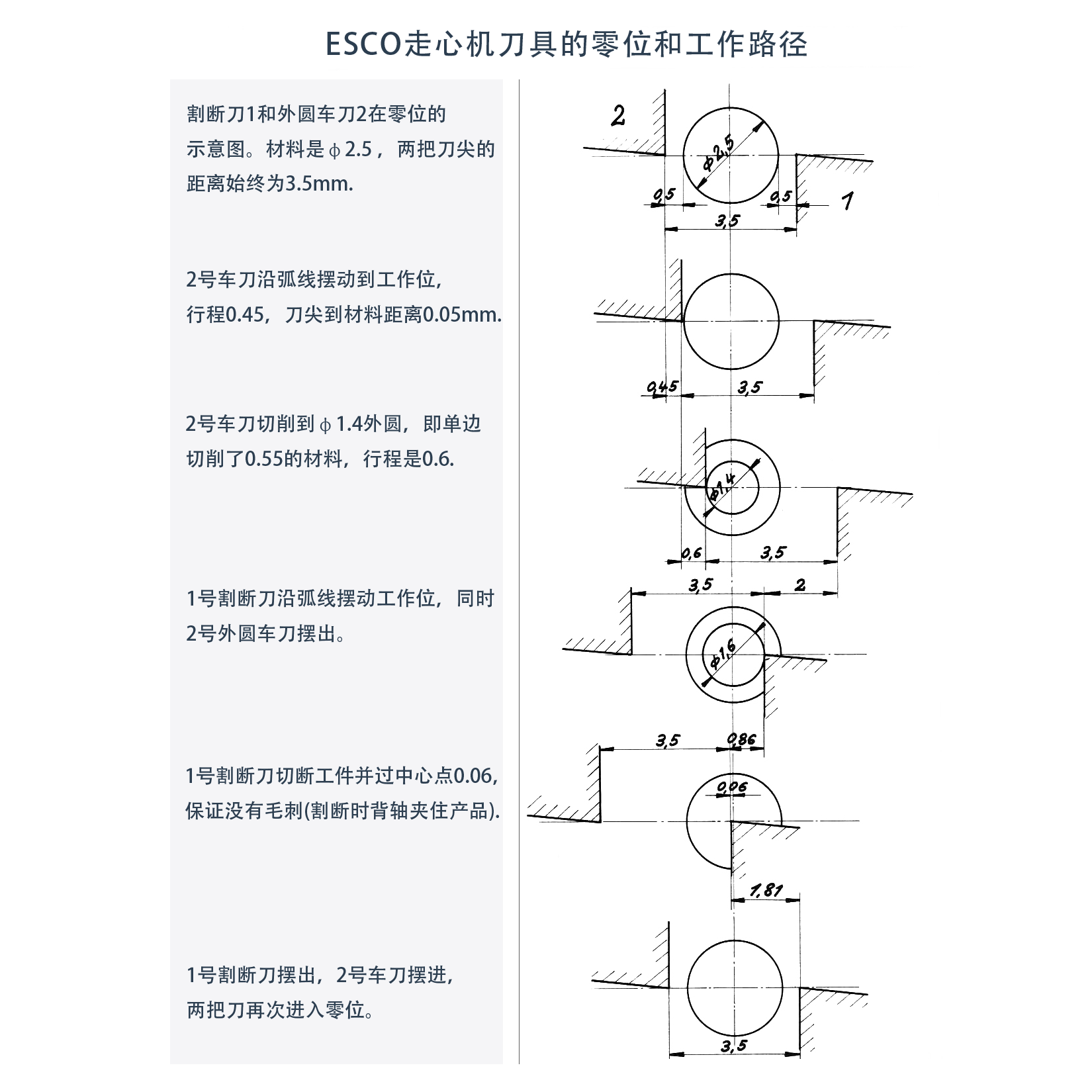
Figure 1: ESCOMATIC tool layout and working path diagram - showing tool zero position setting and multi-process coordinated operation workflow
I. Process Decomposition and Parameter Settings
1. Machining Process Sequence
The ESCOMATIC machining process strictly follows preset process sequences, with each process having clear tool movements and associated actions:
| Process | Tool Action | Associated Action |
|---|---|---|
| a | Tool 2 Cutting: Ø3.5 → Ø2.6mm | Tool 1 Idle Retraction |
| b | Tool 2 Chamfering: Ø2.6 → Ø1.4mm | Tool 1 Retract to Ø5.6mm |
| c | Tool 2 Pause Cutting | - |
| d | Tool 1 Cutting: Ø5.6 → Ø1.6mm | Tool 2 Retract to Ø5.4mm |
| e | Tool 1 Cut-off (0.06mm over center) and Pointing | - |
| f | Tool 1 Pause | - |
| g | Tool 1 Return to Zero Position (Ø3.5mm) | - |
| h | Material Feed 17mm (16mm workpiece + 1mm cut-off width) | - |
| i | Back Collet Close (at end of feed) | - |
| j | Back Collet Open (after cut-off) | - |
Key Rule: When no longitudinal turning is required, the collet remains closed throughout until cut-off completion
2. Process Coordination Principle
The core advantage of the ESCOMATIC cam system lies in precise multi-tool coordination:
- Tool 1 handles cut-off and finishing operations
- Tool 2 handles roughing and chamfering operations
- Back collet ensures stable workpiece clamping
- Material feed system enables continuous production
II. Working Stroke and Feed Calculation
1. Working Stroke Quantification (Unit: 0.01mm)
Precise working stroke calculation is the foundation of cycle control:
| Process | Working Stroke | Calculation Basis |
|---|---|---|
| b (Chamfering) | 60 | Ø2.6→Ø1.4mm = 0.6mm radial depth |
| e (Cut-off) | 86 | 0.86mm cut-off depth |
2. Feed per Revolution (Unit: 0.01mm/rev)
Feed rate settings directly affect machining quality and efficiency:
| Process | Feed Rate | Reference Standard |
|---|---|---|
| b (Chamfering) | 1.15 | Finishing standard value |
| e (Cut-off) | 0.80 | Cut-off standard value |
3. Tool Revolution Calculation
Calculation Formula:
Revolutions = Working Stroke / Feed Rate
Specific Calculations:
- Chamfering: 60 / 1.15 ≈ 52.17 → 52 revolutions
- Cut-off: 86 / 0.80 = 107.5 → 108 revolutions
Total Effective Machining Revolutions = 52 + 108 = 130 revolutions
III. Non-Production Time Conversion (Cam Degrees)
1. Non-Production Action Time Table
Precise control of non-production time is key to improving efficiency:
| Process | Action Description | Cam Degrees |
|---|---|---|
| a | Tool 2 Cutting Approach (0.45mm) | 16° |
| c | Tool 2 Pause | 2° |
| d | Tool 1 Cutting Approach (2mm) | 17° |
| f | Tool 1 Pause | 2° |
| g | Tool 1 Return (1.82mm) | 18° |
| h | Material Feed 17mm | 59° |
| Total | 110° |
Calculation Basis:
- Approach per 0.5mm ≈ 16-20° (Table page 52)
- 17mm feed = 59° (Table page 52)
2. Time Distribution Optimization
Reasonable allocation of non-production time ensures:
- Smooth tool transitions
- Precise material feeding
- Stable system operation
IV. Core Cycle Calculation
1. Time Balance Equation
The core of ESCOMATIC cam automatic lathe cycle calculation is time balance:
Total Cam Cycle (360°) = Effective Machining Time + Non-Production Time + Safety Margin
2. Calculate Actual Tool Revolution Requirement
Available Production Angle Calculation:
- Available production angle = 360° - 110° = 250°
Effective Machining Revolution Density:
130 revolutions / 250° = 0.52 rev/degree
Total Tool Revolution Requirement:
130 × (360° / 250°) = 187.2 → 188 revolutions
3. Capacity Matching Verification
Gear Table Lookup:
- 188 revolutions → 32 pieces/minute
g Factor Correction (empirical factor):
- Analogous to similar workpiece shapes on page 42, take g=1.4
- Theoretical revolutions = 130 × 1.4 = 182 revolutions
- Actual 188 revolutions meet requirements
V. Cam Angle Allocation
1. Calculation Formula
Process Cam Angle Allocation Formula:
Process Cam Angle = (Process Revolutions × 360°) / Total Tool Revolutions
2. Cut-off Process Example
Cut-off Process (78 revolutions) Calculation:
(78 / 188) × 360° = 149.36° → 149°
3. Cam Phase Distribution
0°→149°: Cut-off and pointing
149°→167°: Tool 1 pause
167°→185°: Tool 1 return
185°→244°: Material feed
...(Other processes allocated similarly)
VI. Double Cone Coupling Feed System Advantages
1. Comparison with Traditional Collets
| Index | ESCO Double Roller System | Traditional Collet System |
|---|---|---|
| Clamping Action Time | 0° (continuous clamping) | Requires 8-10° for opening/closing |
| Material Retraction Time | Integrated in cut-off cycle | Additional 15-20° |
| Minimum Cycle Limitation | 32 pieces/minute | ≤25 pieces/minute |
2. Special Handling for Double-End Long Workpieces
Challenges Faced:
- Requires full longitudinal turning → no idle time for feed bar retraction
Solutions:
- Use 40° short stroke cam (replacing standard 65°)
- Remove adjustable limit stops
- Include cam angle in production cycle
3. System Advantages Summary
- High Precision Clamping: Double cone design ensures workpiece concentricity
- Continuous Feed: No need for frequent collet opening/closing
- Cycle Optimization: Reduces non-production time
- Quality Stability: ±0.01mm dimensional stability
VII. Key Formula Summary
1. Effective Revolution Density
K = Total Effective Machining Revolutions / Available Production Angle
2. Total Tool Revolutions
N_total = (Total Effective Machining Revolutions × 360°) / (360° - θ_non-production)
3. Process Angle Allocation
θ_process = (N_process × 360°) / N_total
VIII. Practical Application and Debugging Points
1. Precision Requirements
- Cam phase error ≤0.1°
- Dimensional stability ±0.01mm
- Surface roughness Ra≤1.6μm
2. Debugging Verification
- Use indexing plate to verify cam phases
- Measure actual cutting forces and vibrations
- Monitor tool wear conditions
3. Optimization Recommendations
- Adjust feed rates according to material properties
- Optimize tool geometry angles
- Regularly calibrate cam precision
Conclusion
The ESCOMATIC cycle calculation system achieves high precision and efficiency in micro-shaft machining through precise mapping of cam angle-tool revolutions. This calculation method is not only suitable for Ø2.5mm shaft components but also provides a scientific theoretical foundation for process design of other specification products.
In actual production, accurate cycle calculation is the prerequisite for achieving automated production, while ESCO system's double cone coupling feed technology provides valuable technical reference for the transformation from traditional mechanical processing to modern precision manufacturing.
Through deep understanding of these calculation principles, engineering technicians can better utilize the technical advantages of ESCOMATIC automatic lathes to achieve higher production efficiency and product quality.